
· DigeeMed Editorial
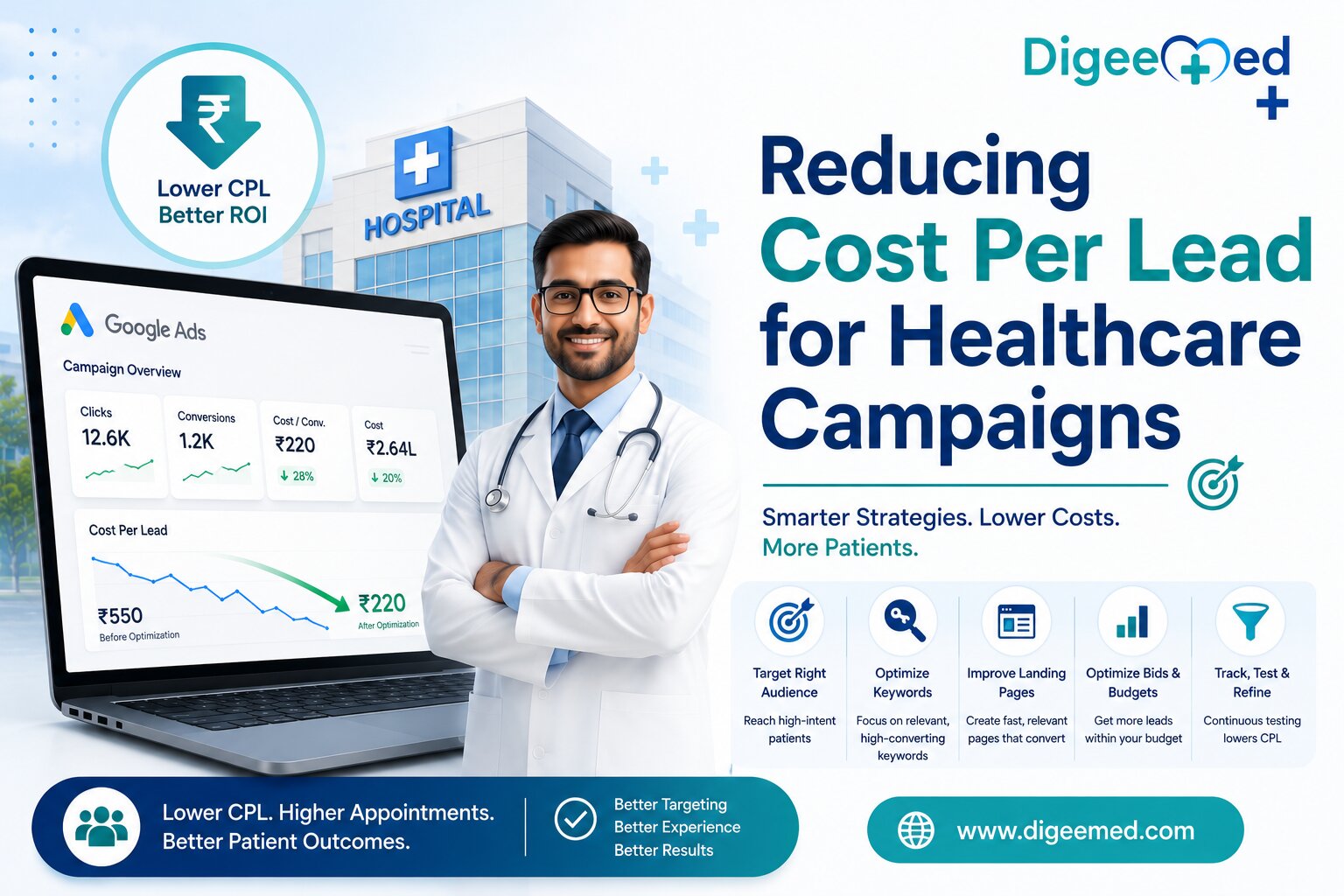
High click costs are a given in healthcare PPC. What is controllable is how efficiently those clicks turn into actual patient enquiries. The goal when trying to reduce cost per lead healthcare isn't to spend less on ads, it's to get more from what's already being spent.
Why Campaigns Struggle to Reduce Cost Per Lead Healthcare
Before fixing CPL, it helps to understand why it climbs in the first place.
The most common culprits:
Broad keyword matching pulling in irrelevant traffic that clicks but never converts
Landing pages that don't match ad intent, creating drop-off immediately after the click
Poor Quality Scores driving up auction costs across the whole account
Budget spreading equally across low and high intent users
Bid strategies set up once and never revisited
Most CPL reduction strategies healthcare teams actually need aren't exotic. They're fixes to fundamentals that got overlooked when campaigns were first built.
Negative Keyword Optimization .
Negative keyword optimization is consistently one of the highest-return activities in any healthcare PPC account and one of the most neglected.
Every irrelevant click costs money. Someone searching "free medical advice" or "how to become a cardiologist" who clicks an ad is pure wasted spend. Healthcare accounts accumulate these search terms quietly and the bill adds up fast.
What effective negative keyword management looks like:
Fortnightly search term report reviews at minimum
Negative lists built at both campaign and account level
Separate lists for research intent queries and career-related searches
Regular checks to prevent keyword cannibalisation between ad groups
Done consistently, this alone can lower CPL healthcare campaigns within weeks without touching bids or budgets.
Quality Score Improvement to Reduce Cost Per Lead Healthcare
Quality Score improvement reduces cost per click structurally rather than situationally. A higher Quality Score means paying less for the same ad position, and that discount applies to every click across the campaign.
Quality Score depends on three things: expected CTR, ad relevance, and landing page experience. All three are controllable.
For healthcare PPC cost optimization through Quality Score:
Tighten ad group themes so each group covers one specific topic
Write ad copy that directly reflects the keywords in that group
Send traffic to dedicated landing pages, not general service pages
Ensure landing page content matches exactly what the ad promised
A jump from Quality Score 4 to 7 on competitive healthcare keywords produces meaningful CPC reduction. Multiplied across hundreds of keywords, that compounds into significant savings over a quarter.
Landing Page Conversion Rate
CPL is a function of two things: cost per click and conversion rate. Most healthcare PPC cost optimization efforts focus entirely on CPC and ignore conversion rate completely.
The math is straightforward. At Rs. 80 CPC with a 4% conversion rate, CPL is Rs. 2,000. Improve conversion rate to 8% without touching CPC and CPL drops to Rs. 1,000. Same spend, twice the leads.
Landing page conversion rate improvements that consistently work in healthcare:
Headline directly matching the ad and the patient's specific concern
Appointment form reduced to minimum viable fields
Doctor credentials and trust signals visible without scrolling
Page load time under three seconds on mobile
Single clear call to action, no competing navigation
Reduce cost per lead clinics often find landing page work delivers faster CPL improvement than bid adjustments, particularly when existing pages are generic or poorly matched to ad intent.
Audience Targeting Refinement for Lower Patient Acquisition Cost .
Broad targeting spreads budget across users with very different intent levels. Audience targeting refinement concentrates spend where conversion probability is actually high.
Practical approaches for lowering patient acquisition cost:
Layer in-market audiences for healthcare on top of keyword targeting
Bid higher for users who previously visited specific service pages
Reduce bids for audiences showing research behaviour without booking intent
Segment by geography and adjust based on conversion performance per location
In metro markets with high CPCs, even modest audience refinement shifts the ratio of qualified to unqualified clicks noticeably.
Ad Copy Testing for Cost-Efficient Healthcare Ads .
Ad copy testing improves CPL from two directions. Better CTR improves Quality Score, which lowers CPC. More relevant copy pre-qualifies clicks, which improves conversion rate.
For cost-efficient healthcare ads, testing should be continuous:
Benefit-led headlines against feature-led headlines
Urgency-based copy against reassurance-based copy
Specific credentials in headlines, "NABH accredited," "15 years experience"
Search impression share alongside CTR to distinguish copy issues from positioning issues
Responsive search ads allow multiple combinations but still need deliberate review rather than leaving Google to optimise without oversight.
Bid Strategy Optimization: Manual vs Automated
Bid strategy optimization depends entirely on account maturity and conversion data volume.
Automated bidding like Target CPA works well when:
The campaign has at least 30 to 50 conversions per month
Conversion tracking is accurate and complete
The account has sufficient historical data to learn from
Manual bidding makes more sense when:
Conversion volume is low
Specific keywords need tighter individual control
The account is too new for automation to work from meaningful signal
Switching to Target CPA before conversion data is sufficient often increases CPL rather than reducing it. The strategy needs data. Without it, Google optimises toward noise.
Conclusion .
There's no single fix that solves CPL across a healthcare account. Clinics that treat reduce cost per lead healthcare as an ongoing process across keyword hygiene, Quality Score, landing pages, targeting, and bidding tend to see CPL improve steadily and stay improved.
