
· DigeeMed Editorial
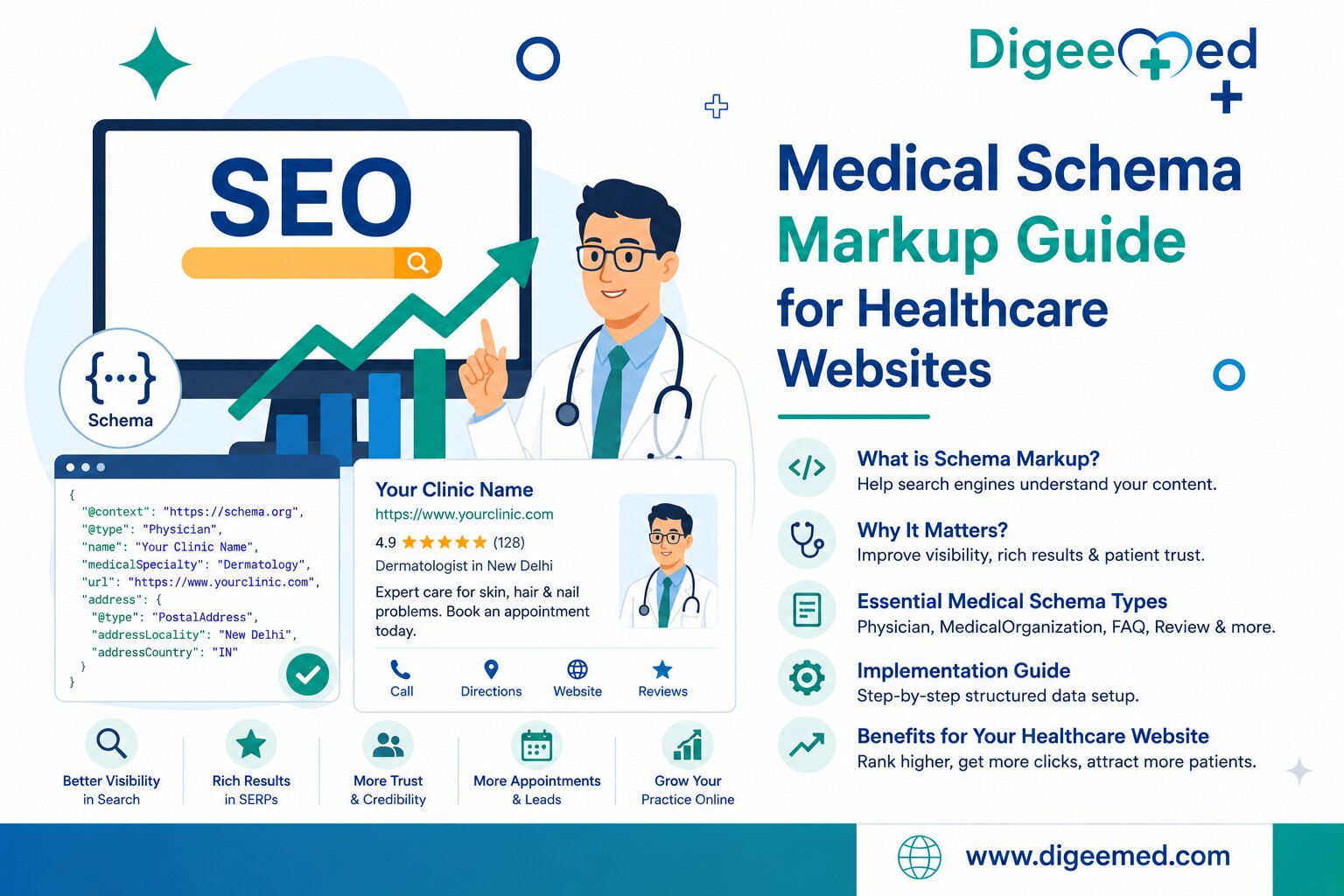
A doctor's website ranking on page one for a search, but the search result showing up as just a plain link with no star rating, no address, no phone number visible. That's what happens when medical schema markup isn't properly set up. Competitors with the same ranking position show their location, their hours, maybe a patient review score right there in the search result itself, and they get clicked more often simply because the result looks more complete and trustworthy than a blank listing.
Schema Markup for Healthcare Websites: The Technical Piece Most Skip.
Schema markup for healthcare websites isn't really optional anymore if a clinic wants to compete fairly online. Search engines still crawl and rank pages without it, but they understand and display results so much better when the markup is there that skipping it leaves real opportunity on the table, specifically in how prominently information shows up in search results.
This matters more than it used to because Google has gotten stricter about what qualifies as quality content in medical spaces, and schema markup helps prove that the information is actually structured, accurate, and from a legitimate source rather than just random text on a page.
Structured Data for Doctors: What Actually Gets Used .
Most structured data for doctors that makes a visible difference comes down to just a handful of schema types, not some overwhelming list of dozens of different markups. A clinic doesn't need to implement every possible schema type to see real benefits, just the ones that actually apply to the specific practice and services offered.
Physician schema markup for individual doctors, hospital schema markup guide for larger institutions, and basic local business schema for clinics handle most of what actually matters for visibility and trust signals in search results. These three alone cover 80% of what most medical practices need.
Schema.org MedicalOrganization: The Foundation .
Schema.org MedicalOrganization is the base template for clinics and practices, telling search engines exactly what kind of organization this is, the services offered, location, contact details, all in a structured format the search engine can actually parse and understand rather than guessing based on page content alone.
Setting this up properly means:
Specifying the exact medical specialty or type of care offered
Including accurate contact information that matches everywhere else online
Adding real address, hours of operation, and accepted insurance if relevant
Listing actual doctor names and credentials when applicable
JSON-LD Healthcare: The Format That Actually Works
JSON-LD healthcare markup is the format most developers and platforms use now, since it's cleaner and easier to implement than older schema formats. It sits in the page's code but doesn't display visibly to patients, search engines just read it in the background to understand what the page is actually about.
A lot of clinics assume schema markup requires technical expertise they don't have, but many website platforms and tools now offer simple schema setup without needing to hand-code JSON-LD directly, making this far more accessible than it used to be.
FAQ Schema for Healthcare and Quick Wins .
FAQ schema for healthcare pages is one of the easiest schema types to implement and one of the most visible in search results. When a patient searches a question, a page with proper FAQ schema can show the answer right there in the search result itself, not just a link they have to click through to read.
For a medical practice, this means FAQs around common questions, symptoms, treatment costs, or what to expect during a visit all become visible in search results if the schema is set up. Patients see the answer they're looking for immediately, and that visibility usually leads to more clicks.
Rich Snippets for Doctors: What Shows Up Where .
Rich snippets for doctors are those extra details that appear below a website link in search results, the star rating, the address, the phone number. Schema markup is what enables these to show up. Without it, that space stays blank, and the search result looks less trustworthy compared to competitors who bothered to set it up.
Review schema matters here too, since a clinic with visible patient ratings right in the search result tends to get clicked more often than one without that social proof showing immediately.
Review Schema for Doctors: Visible Trust Signals .
Review schema for doctors lets patient ratings display directly in search results when the schema is properly implemented. A five-star rating visible next to a clinic's name in search results is a massive advantage over a competitor with the same ranking but no visible reviews.
This doesn't require fake reviews or anything sketchy, just marking up the genuine reviews that already exist so search engines can properly recognize and display them.
Medical Organization Schema Specifics .
Medical organization schema needs to be specific enough to be useful. Marking something as just "healthcare" is too vague. Being specific, "pediatric clinic," "cardiology practice," "dental surgery center," helps search engines understand exactly what services are offered and show the result to the right patients searching for those specific things.
Implementing Schema: Do You Need a Developer?
The honest answer is no, not always. Many website builders and CMS platforms now have built-in schema setup tools that don't require coding. WordPress plugins exist specifically for healthcare schema. But for more complex implementations, especially for larger institutions with multiple services and specialties, having someone who understands the code can help avoid mistakes that would make the markup useless or even confusing to search engines.
Hospital Schema Markup Guide Essentials .
Hospital schema markup guide basics apply just as much to smaller clinics too. Name, address, phone, specialties, affiliated doctors, accepted insurance, emergency services, all of this structured and marked up helps search engines understand what the hospital or clinic actually offers and display that information appropriately in results.
Conclusion .
Medical schema markup isn't really advanced SEO, it's just proper labeling of information so search engines can read it correctly. The payoff comes in search result appearance, click-through rates, and credibility signals that show up immediately when someone's researching a clinic or doctor online. Implementing it doesn't require huge technical resources or developer expertise for most practices, and the difference in how results display afterward is usually immediately visible.
