
· DigeeMed Editorial
If you set aside a particular amount of money for Google Ads, it is highly predictable that for a few months, you cannot tell whether it worked. Nobody connected clicks to actual appointments. That's what happens when hospital Google Ads budget gets decided without linking it to real outcomes first. The question isn't really how much to spend. It's whether the spending produces something measurable back.
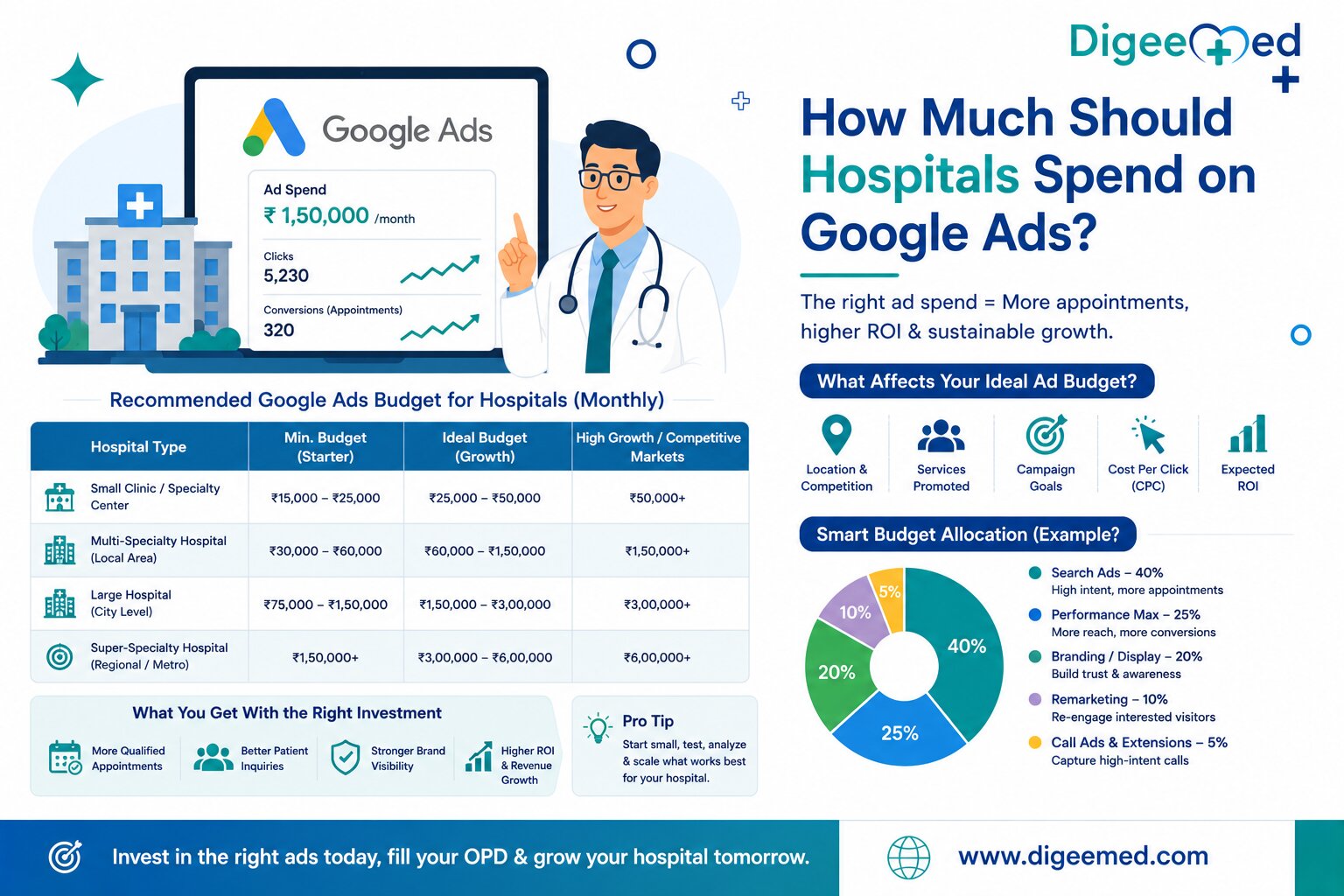
How Much Should Hospitals Spend on Google Ads .
How much should hospitals spend on Google Ads depends on what gets expected in return. Not some standard number other hospitals use. A budget without clear goals attached is just money leaving the account. Tied to patient numbers and revenue targets, it becomes a strategy instead.
Start manageable. Generate enough clicks to judge performance. Decide later whether to expand or pull back. Base that decision on actual numbers, not assumptions made before launch.
Hospital PPC Budget India and Local Differences .
Hospital PPC budget India varies by location significantly. Cost per click healthcare runs higher in competitive metro markets. More hospitals bidding on the same keywords pushes prices up. Smaller cities see lower competition. Lower costs follow.
This isn't about overspending in competitive markets. Understanding that identical budgets produce different results depending on where the hospital operates, that's the point.
Hospital Advertising Budget Based on Size .
A single-specialty clinic doesn't need the same hospital advertising budget as a large multi-specialty facility. Smaller clinic, smaller radius, simpler focus. Larger hospital, multiple services, multiple locations, broader competition.
Growth changes everything. New departments. New locations. New patient types. Each addition needs its own visibility push to reach the specific patients searching for it.
Google Ads Spend for Hospitals by Department.
Departments generate different revenue. Cardiology and orthopedics bring higher-value patients typically. General medicine, different value entirely. Google Ads spend for hospitals should reflect this reality. Treating every department identically misses the point.
Separate budgets per department. This shows clearly which specialties justify the money spent and which ones underperform against their cost.
Department-Wise Ad Budget and Why It Matters .
A department-wise ad budget gives visibility by specialty rather than one combined number covering everything. Shows which departments deliver strong returns. Shows which ones might need cuts or different targeting entirely.
Without this breakdown, just total spend and total clicks exist. With it, specific decisions become possible instead of guessing applied evenly across the board.
Seasonal Ad Spend Healthcare Adjustments .
Certain concerns spike seasonally. Respiratory issues, winter. Infections, monsoon season. Seasonal ad spend healthcare means raising budget during these predictable surges. Pulling back during quieter stretches.
A fixed annual number that never moves misses these patterns entirely. Monthly adjustments based on actual seasonal demand work better than locking spend regardless of what's actually happening that month.
Healthcare Google Ads Cost and What It Means .
Healthcare Google Ads cost breaks into different numbers, each meaning something different. Cost per click shows what each visitor costs. Cost per acquisition hospital shows what each actual patient costs after the entire funnel completes.
These numbers only make sense next to treatment value. High-value procedures justify higher acquisition costs than routine consultations do. Without that context, cost figures alone tell hospitals very little.
Hospital Marketing Budget Google Ads and the Full Picture .
Hospital marketing budget Google Ads works best connected to the patient management system directly. Tracking from click through inquiry, appointment, treatment, billing. Break this chain anywhere, lose the real picture of what's actually working.
Most hospitals just look at clicks. Or impressions. That misses what matters financially. Whether ad spend leads to profitable treatments eventually.
Monthly Ad Spend Hospital Adjustments .
A flexible monthly ad spend hospital approach adjusts based on performance. Not stuck on some fixed number set once and forgotten. Strong months, maybe increase spend. Weak months, maybe fix targeting before adding more money.
Hospitals willing to revisit spending monthly, based on real data, tend toward better results. Compared to those locking in a yearly number regardless of what happens along the way.
Cost Per Acquisition Hospital and Real Profitability .
Cost per acquisition hospital matters more than counting clicks or total spend alone. Stays below what each patient generates in treatment revenue, campaign works. Runs higher than treatment value, hospital loses money on every patient brought through ads.
This calculation needs marketing data connected to actual financial outcomes. Not marketing metrics floating alone, disconnected from revenue.
ROI on Hospital Ads and Measuring What Counts .
ROI on hospital ads becomes clear only by tracking the complete journey. Click to actual treatment revenue. Which keywords brought patients who booked. Which campaigns produced the highest-value patients relative to what got spent reaching them.
Without this tracking, hospitals have spending numbers. Click numbers. No real sense whether campaigns are profitable or just costing money with nothing coming back.
Bigger Spend Does Not Mean Better Results .
More budget brings more clicks. More clicks alone don't bring more patients. Or better patients. Poor landing pages waste budget. Slow response to inquiries wastes budget. Weak follow-up processes waste budget. Regardless of how much gets spent.
Strategy matters more. Targeting matters more. Internal hospital processes around converting interested patients into actual bookings, that matters more than simply raising a number.
Conclusion .
Hospital Google Ads budget decisions work better connected to actual outcomes. Not arbitrary figures decided beforehand. Linking spend to department performance. Adjusting for seasonal patterns. Tracking acquisition cost against treatment value. Reviewing results monthly. All of this contributes to budgets that function as real business tools. Hospitals skipping this tracking, just setting a number and hoping, tend to waste money without realizing where exactly it disappeared to.
