
· DigeeMed Editorial
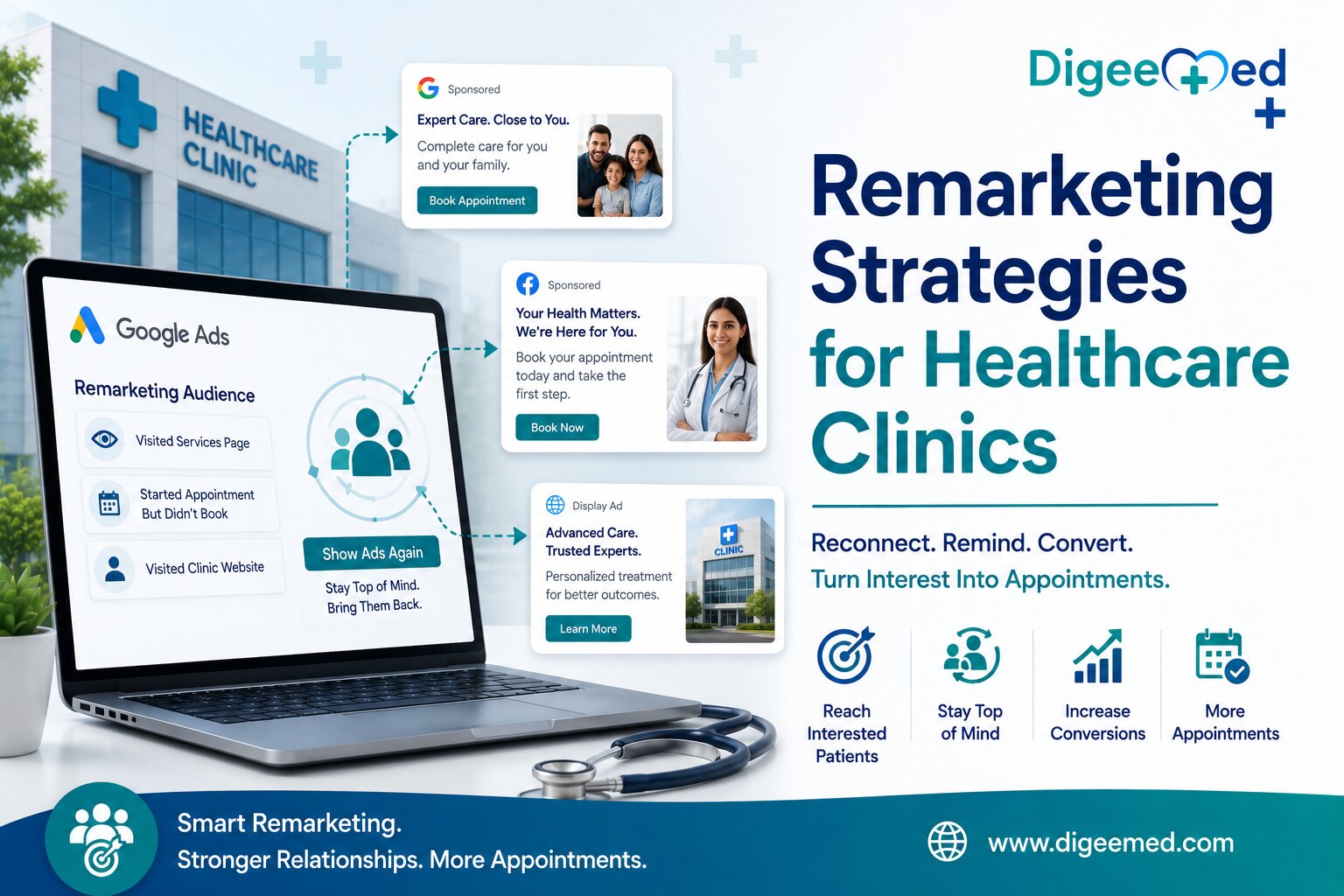
Most people who click a healthcare ad don't book on the first visit. They look around, check a few other clinics, get distracted, and move on. That doesn't mean they're gone. Remarketing for healthcare clinics exists specifically to re-engage those visitors before they end up booking somewhere else.
Done well, it's often the most cost-efficient part of a healthcare PPC setup. The audience already knows the clinic exists. The job is reminding them to come back.
Why Remarketing for Healthcare Clinics Works .
Patient decision cycles are longer than most consumer purchases. Someone researching a knee replacement or fertility consultation isn't booking after one ad click. They're comparing options, reading reviews, possibly discussing with family. The gap between first visit and actual booking can be days or weeks.
Healthcare remarketing strategies account for this by staying visible during that consideration period without being aggressive. The goal isn't to pressure someone. It's to stay present and credible while they decide.
This is also why remarketing for hospital websites works particularly well for elective and planned procedures. Emergency decisions don't have a consideration window. Everything else usually does.
How Remarketing Campaigns for Doctors and Clinics Are Built .
Remarketing campaigns for doctors and clinics start with a tracking tag placed on the clinic website that adds visitors to audience lists as they browse different pages.
The basic setup:
Google Ads remarketing tag or Google Analytics audience import connected to the Ads account
Audience lists built based on pages visited, service pages, booking pages, department pages
Campaigns targeting those audiences with relevant display or search ads
Remarketing list size requirements met before campaigns run, Google requires minimum 100 active visitors for display and 1000 for search remarketing
That last point catches smaller clinics off guard. Low monthly traffic may mean list size thresholds aren't hit quickly enough for certain channels to be viable right away.
Audience Segmentation Remarketing: Not Everyone Gets the Same Ad .
Audience segmentation remarketing is where healthcare remarketing strategies get genuinely effective rather than just functional.
Someone who spent four minutes on the IVF services page is very different from someone who landed on the homepage and left after ten seconds. Showing both the same generic ad makes no sense.
Segments that work well:
Visitors to specific service pages, targeted with ads relevant to that exact treatment
Abandoned appointment booking visitors who started a form but didn't complete it, the highest-intent audience in the whole account
Blog readers, lower intent, better served with educational content than direct booking pushes
Past converters, useful for follow-up services, annual checkups, or related treatments
The abandoned appointment booking segment converts at significantly higher rates than general visitors. The intent signal is already there. A well-timed patient retargeting ad often closes the gap.
Retargeting Ads for Clinics: What the Messaging Should Do .
Retargeting ads for clinics need different messaging than prospecting ads. The person already knows the clinic. Repeating the same awareness-level ad wastes the opportunity.
What works better:
Address the consideration stage directly. "Still thinking about knee replacement? Here's what our patients say" acknowledges the research phase
Lead with trust signals, doctor credentials, accreditations, specific patient outcomes
Offer a lower-commitment next step, a free consultation or callback removes friction for someone not ready to book outright
For abandoned appointment booking audiences, a simple direct reminder often works. Sometimes people genuinely just got interrupted
What doesn't work: heavy discounting as the lead message, overly urgent language, or frequency so high it feels like surveillance. Patients know they're being retargeted and aggressive tone damages trust for a healthcare brand.
Healthcare Display Remarketing .
Healthcare display remarketing puts visual ads in front of past visitors as they browse other websites across the Google Display Network.
Practical format notes:
Responsive display ads are the most practical starting point, they adapt across placements automatically
Image-led ads work when the clinic has strong visual assets, real doctor photos and facility images, not stock photography
For remarketing campaigns for doctors building personal brand, ads featuring the doctor directly tend to outperform generic clinic branding
Placement exclusions matter in healthcare. Display ads appearing next to low-quality or irrelevant content undermine the professional credibility the clinic is trying to build. Exclusion lists are worth setting up from the start.
Frequency Capping Ads: Staying Visible Without Being Intrusive .
Frequency capping ads limits how many times the same person sees a remarketing ad within a set period. In healthcare this isn't optional.
Showing a patient the same ad fifteen times in three days isn't persuasive. For health-related services it feels intrusive. Healthcare brands run on trust and overexposure erodes that quickly.
Reasonable caps for patient retargeting ads:
Display remarketing: three to five impressions per day per user
Search remarketing: naturally controlled by search behaviour, less of a concern
Smaller audience lists need more conservative caps to avoid hammering the same people repeatedly
Email Remarketing Healthcare .
Email remarketing healthcare uses existing patient contact data to re-engage people through email rather than paid display or search.
For clinics with a patient database this means:
Uploading customer match lists to Google Ads to target existing patients with specific campaigns
Running follow-up sequences for patients who enquired but didn't book
Promoting seasonal services like health checkup packages to people who've previously shown interest
Email remarketing healthcare works well for longer consideration cycles because the channel feels less interruptive than display ads and allows more detailed messaging.
Privacy Considerations for Patient Retargeting Ads.
Patient retargeting ads in healthcare need more careful handling than remarketing in most other industries.
Key points:
Google's healthcare advertising policies restrict how audience data can be used in sensitive health categories
Remarketing lists should not be built in ways that imply knowledge of specific health conditions
Dynamic remarketing ads referencing specific medical content a user viewed can cross into policy-violating territory
Consent frameworks on the clinic website need to cover remarketing cookies
The practical rule: target based on pages visited and actions taken, not inferred health status. "Visited the orthopaedics page" is a behavioural signal. "Has a knee condition" is an attribute. The first is fine. The second creates both policy and ethical problems.
Conclusion .
Remarketing for healthcare clinics works best when built around how patients actually decide, gradually, across multiple touchpoints, over a realistic timeframe. Segment properly, cap frequency sensibly, respect the privacy boundaries healthcare requires, and the channel consistently delivers some of the most efficient CPL in the account.
