
· DigeeMed Editorial
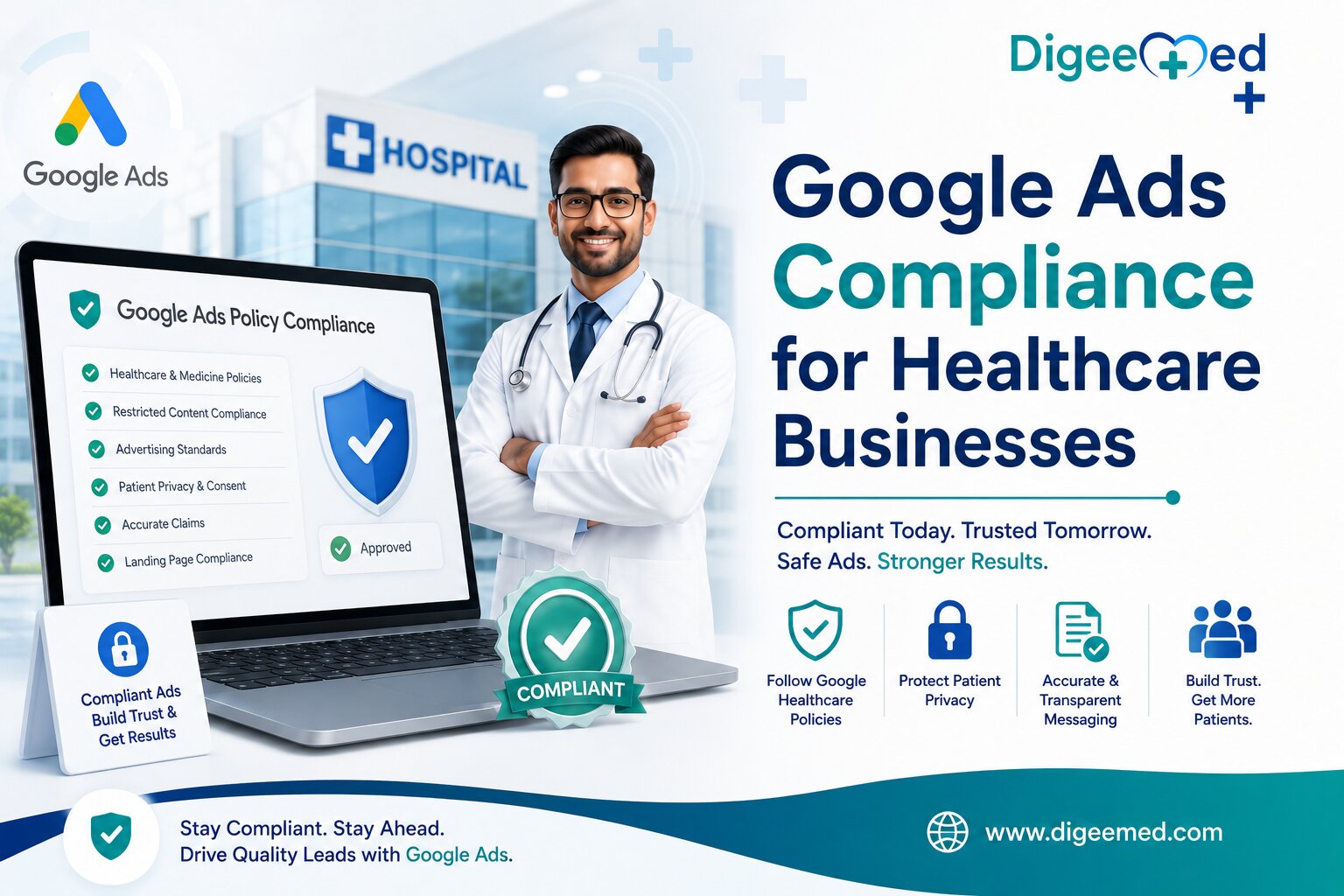
If you've ever had a healthcare ad disapproved without a clear explanation, or had a campaign suddenly flagged after running fine for months, you already know that Google Ads compliance for healthcare operates differently from most other ad categories. It's not arbitrary, but the rules are layered, sometimes inconsistent in how they're applied, and genuinely important to understand before spending serious money on campaigns.
Why Google Ads Compliance for Healthcare Gets Treated Differently .
Google places health and medical content in a sensitive category. The reasoning is fairly straightforward: health ads can influence vulnerable people making significant decisions. A misleading ad for a shoe brand is annoying. A misleading ad about a medical treatment is a different kind of problem entirely.
This means Google Ads healthcare policy applies scrutiny at multiple levels. The ad itself, the landing page it points to, and sometimes the overall account depending on what categories are being advertised. For clinics in India specifically, healthcare advertising compliance India also means navigating any country-level restrictions that layer on top of Google's global policies.
Most general clinics and hospitals don't hit the most complex compliance requirements. But even standard campaigns for routine services can run into problems if copy is carelessly written or landing pages don't line up with what the ad actually promises.
The Basic Policy Tiers Worth Knowing .
Google Ads rules for medical ads organise health content into tiers. Not everything gets treated the same way.
General health services, clinics, hospitals, most elective procedures: permitted under standard compliance rules
Certain pharmaceutical categories, addiction treatment, clinical trial recruitment: permitted only with relevant certification or verification
Some categories are country-specific, allowed in certain markets but not others
A smaller set is prohibited entirely: counterfeit medicines, unapproved substances, content promoting genuinely unsafe practices
For the vast majority of Indian clinics running search campaigns for their core services, formal certification isn't required. The complications usually come from how the ads are written, not from the category itself.
Healthcare Advertiser Verification: When It Applies .
Healthcare advertiser verification is a formal process, not something every advertiser goes through. It becomes relevant when campaigns touch regulated territory.
Specifically:
Online pharmacies need to complete the Google Ads certification process and provide proof of accreditation before ads are approved
Prescription drug ad policy compliance is required before any campaign references medications by name
Addiction treatment services face specific verification requirements that vary by country
Google healthcare certification ads for pharmaceutical categories require documentation Google reviews before the account can run those campaigns
A general dentist or orthopaedic clinic doesn't need to go through this. But the moment a campaign starts referencing specific medications, regulated treatments, or anything touching the pharmacy space, verification becomes mandatory and needs to be sorted before ads go live, not after disapprovals start coming in.
What Actually Gets Ads Disapproved .
This is where most clinics run into trouble because the ad disapproval reasons healthcare teams encounter are often things that seemed fine when the copy was written.
The main ones:
Superlatives without any evidence behind them. "Best cardiologist in Delhi," "highest success rate," "most advanced technology." Google's misleading health claims policy flags these unless there's something verifiable backing the claim
Guaranteed outcome language. "Permanent solution," "get back to normal in two weeks," "guaranteed results." Any copy that frames an outcome as certain rather than possible is a problem
Before and after imagery that implies dramatic or predictable results
Prescription drug references in ad copy without the relevant certification in place
Landing pages that don't match what the ad said. This one catches people off guard because the disapproval comes at the page level, not just the ad level
Emotional urgency that exploits health anxiety to push someone toward immediate action
The grey area sits around technically accurate statements that are framed in misleading ways. A clinic might genuinely have an excellent success rate for a procedure. But writing "guaranteed success" instead of "strong clinical outcomes" is the difference between a compliant ad and a disapproved one.
Restricted Healthcare Terms: The Keyword Layer .
Restricted healthcare terms add another layer to campaign planning that purely traffic-focused keyword research misses.
Some things worth knowing:
Prescription drug names are heavily restricted under prescription drug ad policy and generally can't appear in ad copy or as keywords without certification
Certain keyword combinations trigger automatic policy review even if individual words look harmless
Terms related to abortion services, some mental health treatments, and controlled substances face varying restrictions by country
The practical implication is that keyword research for healthcare campaigns needs a compliance check, not just a volume and competition check. A keyword that looks ideal from a traffic perspective can create account-level problems if it pulls campaigns into regulated territory unexpectedly.
How to Keep Campaigns Compliant Without Gutting Ad Performance .
Compliant healthcare advertising doesn't mean boring or ineffective advertising. It means being specific, factual, and honest about what the clinic offers rather than reaching for superlatives and outcome guarantees that create policy risk.
What works in practice:
Describe the service and the process rather than the outcome. "Comprehensive knee replacement programme with post-surgical rehabilitation" clears policy far more reliably than "get back on your feet in weeks"
Use doctor credentials and clinic accreditations as trust signals rather than comparative claims
Check that landing pages actually reflect what the ad says, this is one of the most common sources of disapprovals and one of the easiest to fix
Review Google's healthcare and medicines policy page at least once a quarter, these do get updated and campaigns that were compliant can get flagged after a policy change
Monitor disapproval notifications actively rather than finding out when performance suddenly drops
For hospitals running multiple campaigns across departments, healthcare advertising compliance India is easier to manage when one person owns policy review rather than leaving it spread across different campaign managers with no central oversight.
Conclusion .
Google Ads compliance for healthcare is less about memorising every rule and more about building habits that keep campaigns clean. Factual copy, matched landing pages, regular policy reviews, and active disapproval monitoring cover most of what clinics need to stay compliant and keep campaigns running without sudden interruptions.
