
· DigeeMed Editorial
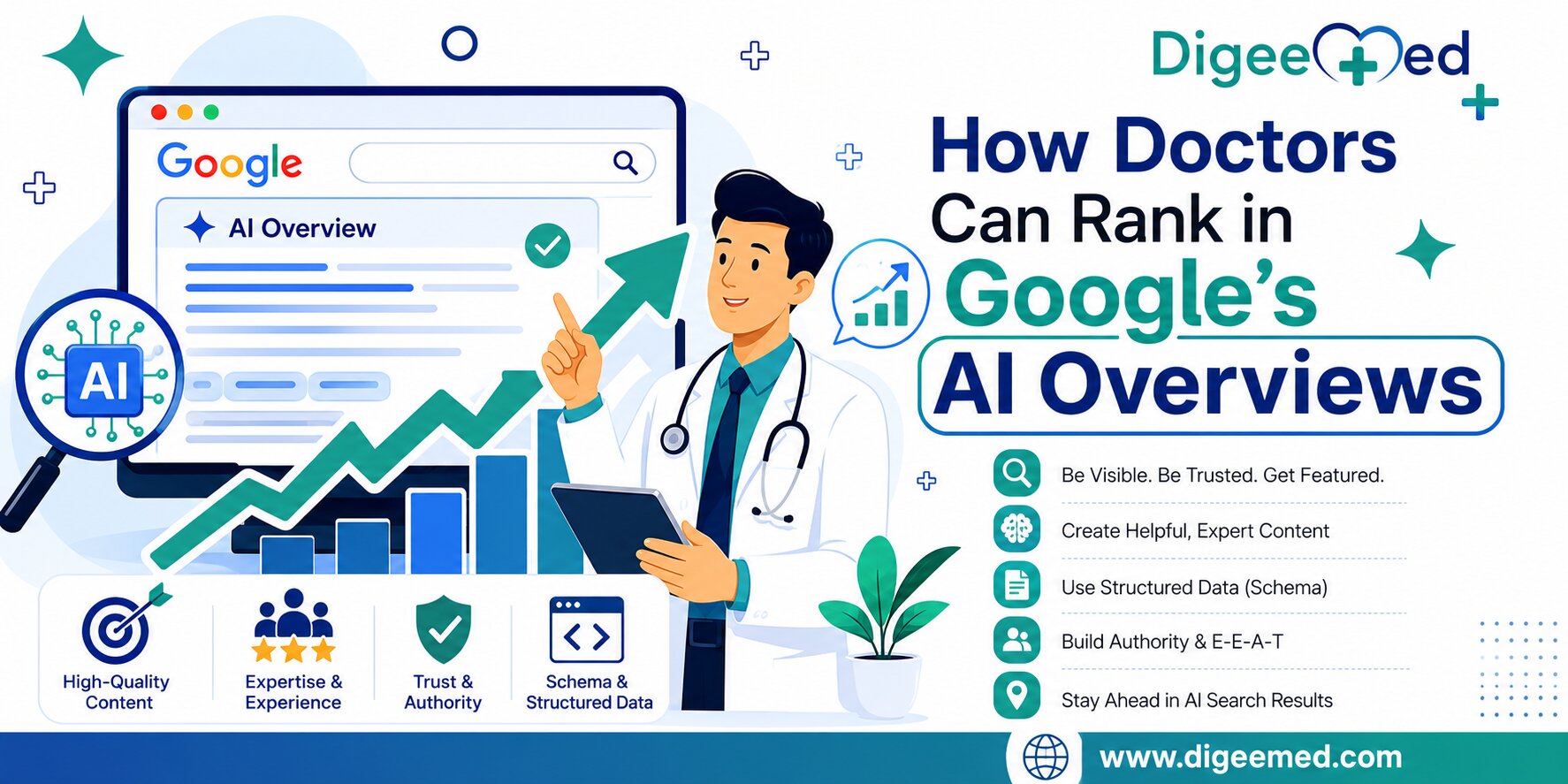
Search results do not look the way they used to. Now Google often gives an answer right at the top, before anyone clicks a single link. For doctors and clinics, this is a problem if their website is not built for it. To rank in Google AI Overviews for doctors, the content on a site has to match what these AI summaries look for. Otherwise the page sits lower down, even if it used to do fine before.
Why Doctors Need to Rank in Google AI Overviews .
A lot of patients now ask a question and get an answer box, not a list of links. That box pulls from a small number of sources Google trusts. If a clinic's site is not one of them, the page might rank fine on paper, but fewer people will scroll down to see it.
This matters a lot for Google AI Overviews healthcare pages because the field is crowded. Big hospital sites and large health publishers already have a head start. A small clinic or single doctor's page has to be sharper about it, not just longer. People are getting answers without clicking anything now, and trust matters more than keyword count. Pages written for real questions tend to do better than pages written for Google alone.
What Actually Affects AI Overviews SEO for Doctors .
AI Overviews SEO for doctors is not really about stuffing in more keywords. Google's AI reads the page, tries to understand what it is saying, and checks if it answers the question well. Pages that get picked usually answer something clearly, near the top, in plain words. The answer shows up early, not buried in paragraph six. Headings sound like real questions, not marketing lines. The writer's medical background is visible somewhere, and the page loads fast and works fine on a phone.
A page covering five topics at once usually does worse. One page, one question, answered properly. That is most of ranking in AI search results in a nutshell.
Writing Healthcare Content for AI Overviews .
Good healthcare content for AI Overviews starts with how people actually talk. Nobody types "etiology of cephalalgia." They type "why do I keep getting headaches." Content that matches plain speech gets picked up more.
A workable structure for most health pages:
A short, direct answer right at the start
A few short paragraphs explaining why, in simple words
A small list of symptoms or steps if it fits
A short wrap-up line at the end
This is also where conversational search queries come in. These are the questions people actually say out loud or type into Google in normal language. Writing toward these phrases, instead of stiff medical terms, tends to match more of what AI Overviews pull from.
Trust Signals: E-E-A-T for AI Overviews .
Google cares a lot about who is saying something, especially for health topics. This is usually called E-E-A-T for AI Overviews: Experience, Expertise, Authority, Trust.
Medical content is risky if it is wrong, so Google checks this closely. Pages do better when they show the doctor's name, license, or specialty somewhere clear. Linking to outside sources like the CDC helps too, as does keeping the page updated instead of leaving old advice sitting there for years.
Structured Data for AI Search: Why It Helps .
Structured data for AI search is a way of labeling a page so machines do not have to guess what it is about. Without it, Google has to figure things out on its own, which is slower and less reliable.
Featured Snippets and AI Search Visibility for Doctors .
Featured snippets and AI Overviews are not the same thing, but they tend to like similar pages. A page already ranking as a featured snippet often has a decent shot at showing up in an AI summary too. The habits are mostly the same: answer one thing clearly, use a heading that sounds like a real question, do not pad it just to look longer. AI search visibility for doctors comes down to doing this consistently across a site. Featured snippets healthcare content tends to share this same plain setup.
Generative Search SEO for Healthcare, In Practice .
Generative search SEO healthcare work looks different from older SEO habits. Keyword stuffing does not really work anymore, since the AI reads for meaning, not word count. A page written in normal language can still rank if it actually answers the question well.
This whole idea sometimes gets called answer engine optimization, since the goal shifts from getting a click to becoming the actual answer shown on the screen. A simple way to work on this is to look up real patient questions using tools like "People Also Ask," answer each one in its own short section, cut anything that does not add a fact, and check later which pages show up in AI-generated search summaries so the ones that do not can get fixed.
Conclusion .
For simple questions, traffic probably does drop a bit. But for anything more complicated, like treatment choices or finding a doctor nearby, people usually still click through. A short AI summary about symptoms is rarely the end of someone's search if they are actually worried about their health. Clinics with solid, complete pages tend to pick up that follow-up interest even as quick answers move higher up.
